
A certain hope
While the world is burning

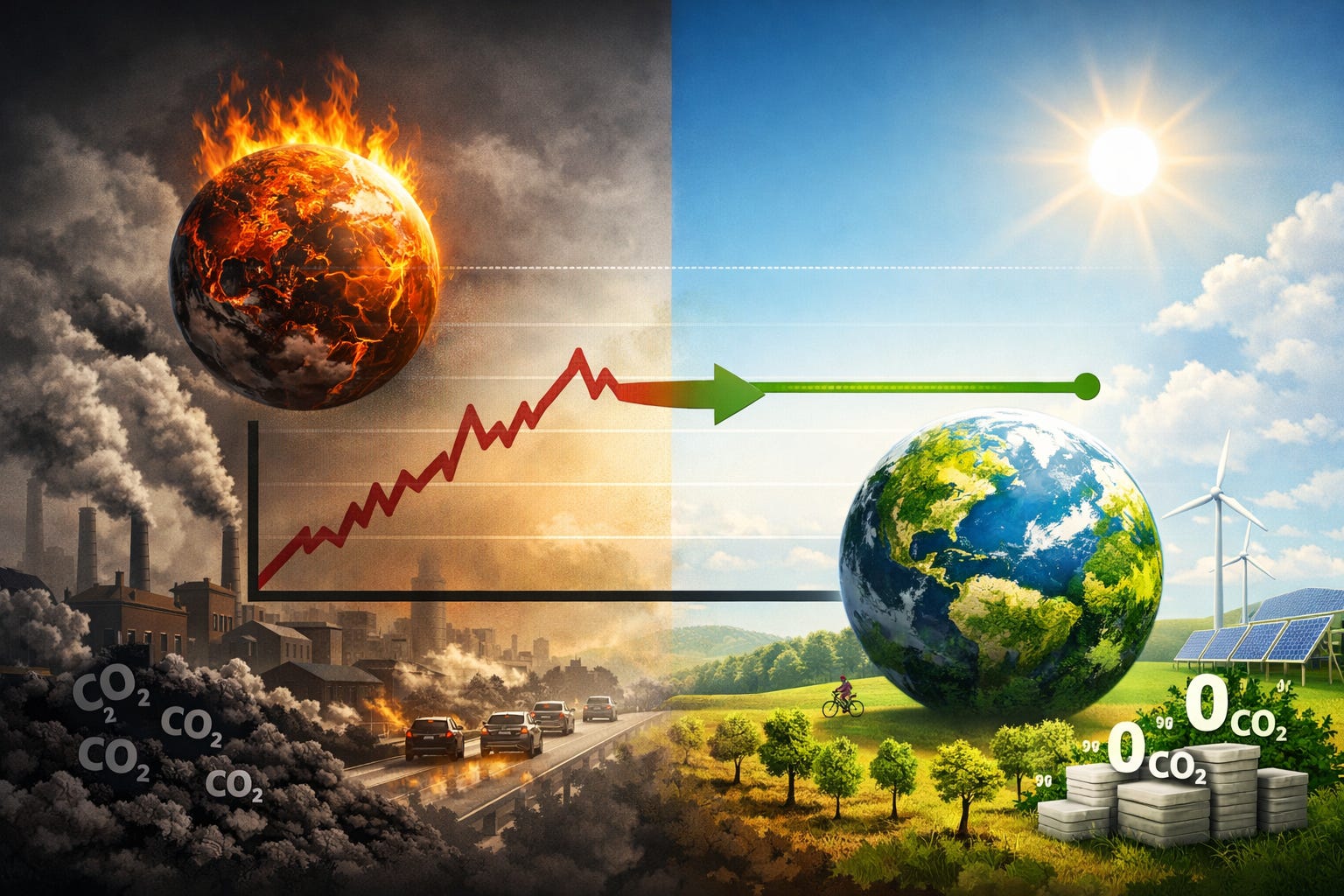
The world is on fire just right now. Not so much that we stop doomscrolling , but enough that every news app feels like a smoke alarm without an off button. War threatens, the climate is cracking, democracy is coughing up blood, inequality is pulling away like a Tesla on the autobahn. At the same time, advertising smiles at us and whispers: Have you tried yoga?
Introduction
The news makes the world feel like it is constantly collapsing: war, climate change, democratic decline and growing inequality. At the same time, advertising tells us to fix ourselves. But important change happens quietly. Power slowly shifts as workers kepp fighting for their rights. Green energy expands fast, challenging fossil fuels all over the world and in China, India, the EU and the US. Tech giants face growing regulation. Support for war is weaker than often assumed, even if conflicts continue. Everyday life in the past was often harsher than today. The core problem is the demand that individuals stay happy while systems fail. Reality includes suffering. Progress comes from dissent, collective action and an economic view that focuses on real resources. Happiness appears in moments of meaning, responsibility and solidarity, not constant success. /End of introduction
Change is working silently
The news feed chases crashes. It gets clicks. The slow improvement is rarely being videotaped, but it happens anyway . It often happens as a power shift: work takes back some leeway, while capital loses an old advantage. Authoritarian leaders like to build community on fear, experiences of disaster situations and lure with nationalism, racism or religious contradictions.
The struggle between labor and capital continues
When productivity is accelerating, albeit at a declining rate , and wages are lagging behind, a choice arises. Unions and politicians now decide whether the union will remain relevant. Members can drop out if they do not see results: higher wages, safer conditions, a better working environment and real influence at work. At the same time, too harsh a grip on workers historically threatens productivity growth. Even in ancient times, inventors had the precursors to steam engines and other devices of industrialism . But they did not come to productive use because slaves were available as cheap labor.
Green energy is starting to challenge
As energy shifts to solar, wind and batteries, the fossil fuel economy is losing control, even though fossil fuel extraction is still increasing. But in India , solar energy is taking over and making coal power unprofitable. Solar energy is also winning in the US despite Trump . The EU is cutting emissions by 2.5 percent in a year while the economy continues to grow. Fossil electricity production is leveling off globally for the first time since the pandemic, and in China, emissions fell in 2025 as solar and wind power take over increasingly large parts of the energy system. This is important because China has long been one of the countries that has primarily kept greenhouse gas emissions up , as the world has relocated its factories there.
The US also faces another problem: shale fields require constant new drilling as older wells are rapidly running out . The US can maintain its lead in energy, but then the country also needs to gain in electrification, grids, storage and efficiency.
Global warming will largely stop when carbon dioxide emissions reach zero . How quickly the world reaches net zero emissions is determined by future temperatures, not historical emissions.
The EU and several of its countries are introducing climate tariffs . They force exporting countries to choose between paying fees to the EU or introducing their own carbon pricing. This has already prompted countries such as Turkey, Mexico and Brazil to change course. Through its market size, the EU can make its own climate requirements a global, economic necessity.
Tech giants face resistance
For many years, platforms grew like private states. Now they are facing backlash. The EU has already handed out large fines under the Digital Markets Act and demanded changes that would open up the market. In the US, the state is pursuing major competition cases against Google . The EU is starting to understand the dangers of being dependent on US tech giants.
A small hope for more peace
Wars and armed conflicts still exist, and the world has had many bloody years. But there is still a certain tendency towards more peaceful relations between countries and fewer deaths due to war. However, there is most certainly a severe break in the development towards peace right now. The hopeful matters its that many world leaders are protesting against warmongers as Trump especieally when he is threatening Denmark. The UN Charter also prohibits violence between states, and almost all states have supported that norm in words, even when they violate it in action. Support for peace is seen in the fact that only about half of adults in the world would be willing to fight in a war for their country. A third would not want to at all and 14% are unsure. This indicates a declining general enthusiasm for war . In Ukraine too, people are tired of the war and 70% want peace now, as soon as possible, through negotiations. They do however probably not want to concede too bigh territorial losses.
Everyday life “in the past” wasn’t always golden
Working life was brutal even during the period of the People’s Home. When my father loaded goods at the port, he occasionally risked getting his head smashed in the process. The care of the mentally ill was cruelly degrading before the reforms of the late 20th century. A friend who drove trucks in the 1970s told me that the driver’s cabs often had no floors. Even in the 1980s, there were still many apartments in a state of disaster that the million-dollar program had not had time to replace. Today, there is a wide range of different sports, TV programs, leisure activities and opportunities for different lifestyles. Homosexuality was no longer illegal. Semlors could only be bought at certain times of the year.
It’s not all up to you.
The message is consistent. Smile more. Optimize yourself. Think positively. Buy the right thing. Then the world will be right. Or at least your face on LinkedIn.
There is a fundamental flaw here. Not in yoga. Not even in the face. The flaw lies in the idea that life should feel like a constant update of “successful, happy and thoroughly good”. As if life were a thesis where everyone gets an A – as long as they put in the right amount of effort and choose the right skin cream.
Suffering is a part of life
Reality behaves differently. It always contains a certain amount of suffering, friction and imperfection. Knees ache. Relationships chafe even when they bring joy. Worry creeps in at three in the morning. No app will fix it. No mantra erases the basic conditions. If you try anyway, the result will not be happiness, but stress with better marketing.
The demand for happiness on you increases
At the same time, something strange is happening. The more the world objectively collapses, the harder the demand for individual happiness becomes. As if the risk of a third world war were an area of personal development. If you fail to feel harmony when the glaciers melt, then you probably just have the wrong mindset .
This is where the troublesome types step in. The ones who deviate. The ones who strike, demonstrate, write angry letters or ask difficult questions at meetings. The ones who refuse to accept that everything has to feel great when the systems don’t. Society often sighs at them. A little embarrassing. A little uncomfortable. Couldn’t they just meditate instead?
Positive influence from insightful deviants
History shows otherwise. Insightful dissenters have more influence than you think. Strikes change the balance of power. Demonstrations create cracks in what seems natural. Opinions that are first called unrealistic later become self-evident. It happens slowly, but it happens. Progress rarely sounds like applause when it begins. It sounds more like a creak.
Scientific view of economics helps
This is where the economy comes in, to everyone’s surprise. Because behind much of the stress, inequality and climate destruction lies an economic system that pretends that the state is a household , even though it controls entire societies. A system that says the money is gone when it’s really our imagination that’s failing.
A more sober view shows something liberating. The state can always finance what there are resources for. Work, knowledge, technology and nature set the limits – not numbers in an account. If we use this insight wisely, we can build a society with shorter working hours, strong welfare and long-term investments in climate and security. Less panic. More planning. Fewer fire brigade calls in suits. For a long time, Hollywood films were mostly on the side of power , but films in recent years such as Barbie and Superman show hope for the opposite.
Mortality remains imperfect
It doesn’t solve everything. It never solves everything. Basic existence remains imperfect . People get sick. Love has challenges even when it’s wonderful. The world rarely surprises only positively. But the pressure to be constantly successful can let go. Space arises for something more reasonable.
Balance between responsibility and rest
There, in that crack, lives a different kind of peace. Not the one sold in commercials, but the one that emerges when you acknowledge the situation and still do your best . When you accept that life contains resistance and at the same time choose consideration, compassion , responsibility and solidarity. When you stop playing the main role in your own success story and instead become a pretty decent supporting role in a larger context.
Happiness then does not manifest itself as a permanent state. It comes in short moments. In a laugh in the midst of misery. In a feeling of having done the right thing, despite limitations. In the knowledge that you don’t have to be perfect to be valuable.
The world can still fall apart. The climate still demands action. We need to defend democracy every day. But at least we can avoid the idea that everything would be solved if we just smiled a little more. At the same time, we can remind ourselves that there is very positive news that the mass media’s headlines and fliers miss.
It goes a long way to do the best you can. Not because it’s easy. But because it’s true.